The Stew Mac site also said that highly figured woods are difficult to bend because they want to crack on the flames, just what my practice pieces did. They suggested lightly wetting the wood with a brush and using more heat and less water to make the bend. I was paranoid enough to try this and it worked for the sharp bends of the cutaway but it took forever to get done. I really babied the wood, used a backing piece of thin metal as a support and what usually would take me 15 minutes took well over an hour. For the side with just the recurves I went back to my usual 30 minute water soak and the process took about 15 minutes to get done. The gentle curves didn't scare me like the cutaway did and I might have gotten away with it but I didn't want to chance it. The sides were clamped in the mold and "cooked" with my halogen spots just like the uke sides detailed in a previous build on this blog.


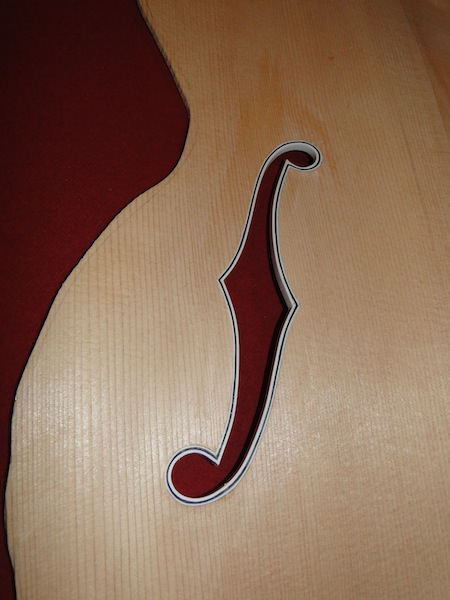
The "f-holes" were lined with plastic bindings.. These will help support the fragile scallops, cover the end grain and add beauty to the finished guitar. I used two layers of .020 white and black binding covered by a .040 white on the inside. Each layer is made up of four pieces. I started with the pieces that go around the round holes. The round profile was pre-bent using a dowel so that there were no kinks in the binding. I used thick CA glue for the piece that butts up to the wood and thin CA for the other layers. The thick CA doesn't get sucked up into the end grain of the wood and the thin CA is really easy to work with for plastic-plastic joints. I used butt joints rather than the 45 degree miters described in the book. I have found from other plastic binding projects that is is very difficult to spot the butt joints on the finished project. One other point is that the edges of the "f-holes" lie at different elevations on the front plate. Because the edges of the "f-hole" are parallel to the guitar sides,you need fairly thick binding material to be sure to have enough depth to cover the entire hole profile. In my case 1/4 inch width binding material did the trick. Because I am cautious, I did the binding prior to setting the final thickness of the top plate. This way if something happened during binding the "f-holes" I could compensate by taking material off of either the top or bottom of the plate.